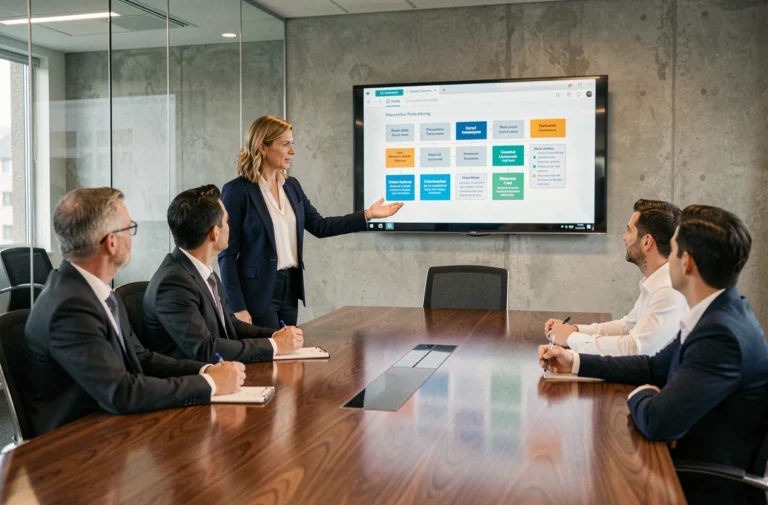
In a world where technology is evolving at breakneck speed, the future of office work is shaping up under the banner of artificial intelligence (AI) and automation. These advancements promise to radically transform work practices by simplifying and speeding up routine tasks. AI, with its sophisticated algorithms, is already capable of performing complex data analyses, while automation allows for more efficient management of workflows. The impact on productivity and efficiency could be significant, but these changes also raise questions about the evolution of jobs and the future skills required by professionals.
Impact of Artificial Intelligence on the Evolution of Office Tools
The integration of artificial intelligence into office tools represents a silent yet decisive revolution for the future of office work. Computer vision, for example, already leveraged for industrial applications such as ejecting defective products or assisting in driving, finds unprecedented applications in the office. Imagine scanners capable of understanding and categorizing documents without human intervention, or video conferencing systems that automatically adjust framing and focus for each participant.
Gesture control technology, offering a future without buttons or contact, particularly interests manufacturers like BMW, mentioned by Tic-et-net.org, which is already integrating it into its infotainment systems. These controls promise a more intuitive interaction with machines, reducing the learning curve and increasing accessibility, especially for people with disabilities or those less comfortable with traditional interfaces.
Natural language processing (NLP) and low-code platforms are two other major development areas. NLP enables machines to interpret human language, paving the way for increasingly capable virtual assistants that can understand complex queries and provide relevant answers. As for low-code, it democratizes the creation of customized applications. Professionals, without advanced programming skills, can now design solutions tailored to their specific needs, revolutionizing how work is performed and managed on a daily basis.

Automation and Artificial Intelligence: Towards a New Era of Productivity
Automation combined with artificial intelligence is forging a future where productivity is set to experience unprecedented acceleration. Expected to radically transform professional environments in the next five years, these technological advancements promise to reduce repetitive tasks and increase the efficiency of business processes. Extreme personalization, powered by AI, positions itself as a formidable marketing tool, capable of offering experiences ‘for you and only for you,’ as evidenced by the approach of services like Spotify in creating tailored playlists.
Process automation, requiring a centralized command center for AI, is becoming a key element in corporate strategy. Products like ProcessMaker IDP illustrate this imperative by facilitating the orchestration of document tasks. At the same time, the challenge of big data looms large: every entity faces the necessity of managing an ever-expanding mass of data, a challenge that automation and AI algorithms are striving to solve effectively.
The question of AI for everyone raises concerns about the acceptance and control of these technologies. Google’s futurist, Ray Kurzweil, predicts an increasing integration of AI into our lives, envisioning a human-machine synthesis in the 2020s, imagined as a direct interface with the neocortex, disrupting our relationship with technology and questioning the balance to be found between advancements and ethics.
Companies like BMW, IKEA, and Samsung are already illustrating the integration of these technologies into their products. BMW uses gesture controls for its infotainment system, IKEA reconfigures rooms in various styles using augmented reality, and Samsung deploys advanced camera technologies. These concrete cases demonstrate that automation and AI are no longer confined to the imaginations of futurists but are firmly rooted in the realities of today’s industry.