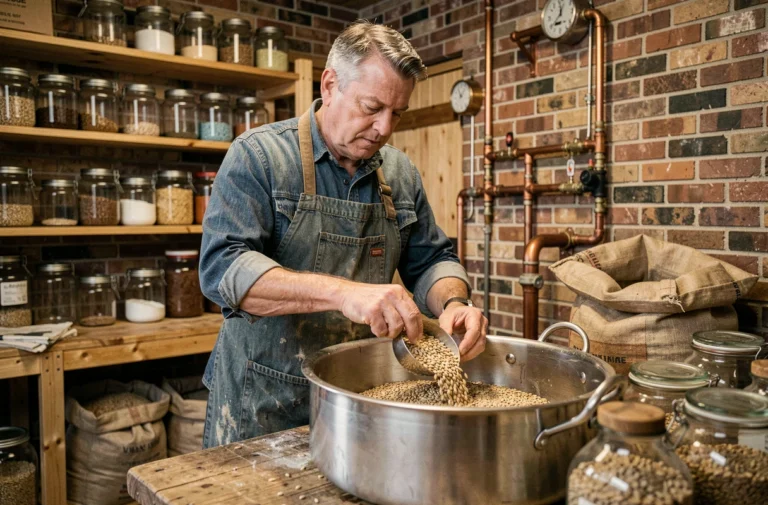
The majority of online tutorials overlook the essential technical details needed for successful DIY projects. Some platforms prioritize the quantity of tips over the reliability of advice. Users then find themselves faced with a collection of unsuitable or incomplete solutions. Oh Brico offers a structured selection of resources, validated by industry professionals, to navigate these common pitfalls.
Oh Brico: a platform dedicated to all DIY enthusiasts
The Oh Brico site stands out as a reliable reference for those who want to combine rigor and practicality without losing sight of technique. Here, each sheet, each tutorial, each technical file is rooted in the concrete experience of building professionals. Lime, mortars, coatings, heritage renovation: the platform details the materials, explains their properties, and specifies the appropriate uses. Lime, a true cornerstone of the site, is explored in all its forms: air lime, hydraulic lime, quicklime, slaked lime, not forgetting the distinction between pure limestone, clayey limestone, and dolomite.
A network of recognized lime manufacturers regularly contributes to the site, ensuring that the sheets are updated and compliant with European standards (CL, DL, NHL). Users benefit from detailed content on product classification, traceability of raw materials, and the crucial difference between calcareous lime, dolomitic lime, and natural hydraulic lime. Comparative tables, educational diagrams, and application tips clarify the entire transformation cycle, from limestone to quicklime, then slaked lime, up to the final carbonation.
Oh Brico does not stop at describing properties: the site weaves connections between materials, between lime and pozzolana, between hydraulic setting and air setting, between reactions to water or CO₂. Each use is placed in its context: masonry, coatings, stuccos, washes, soil stabilization, disinfection, wood treatment. The platform bridges ancient know-how and innovations, strict standards and artisanal adaptations.
What are the essential tips and tricks for successfully completing your projects?
Understanding the nature of lime
The different types of lime, fat, lean, natural, artificial, are distinguished by their uses, reactions, and specific qualities. Fat lime, rich in calcium hydroxide, is favored for fine coatings due to its soft texture and high yield. Lean lime, more austere, is suitable for mortars requiring less plasticity. Knowing the difference between air lime and hydraulic lime is game-changing: the former hardens slowly in the air, while the latter sets with water, making it an ally for damp or buried supports.
Mastering dosages and reactions
For each project to hold up, certain balances must be respected:
- The lime-sand mix ratio: too much binder, the mortar cracks; too little, and the strength is lacking.
- The adjustment of water: the consistency must remain pliable without being liquid or running.
- The addition of pozzolanic aggregates (pozzolana, tile waste, ashes) enhances hydraulic setting, valuable for heritage restoration.
Anticipating setting and durability
The choice between air setting or hydraulic setting influences the pace of the project. Air lime requires patience: its carbonation, a slow reaction with the CO₂ in the air, forges lasting strength. Hydraulic lime, on the other hand, allows for quick formwork removal, particularly useful on damp supports. Each participant ensures the compatibility of materials and the quality of application to avoid unpleasant surprises.
Seeking experienced advice
On Oh Brico, practitioners, artisans, and architects share their experiences. The sheets explain the difference between calcium hydroxide and calcium oxide, detail the reactions of lime with water, CO₂, or aggregates. The advice is based on feedback from experience, from quicklime to slaked lime, to ensure a reliable result tailored to each structure.
Practical resources to go from idea to realization, even without experience
Oh Brico stands out as the go-to resource for those who want to progress, whether it’s lime masonry, coatings, or washes. The navigation is designed to guide each step, from transforming limestone to quicklime, then slaked lime, up to ready-to-use mortar. The applications are numerous: use of lime, restoration, maintenance of old surfaces.
The site focuses on transmitting accessible know-how. The guides explain in detail the differences between air lime and hydraulic lime, the benefits of stucco or wash, and the preparation of a custom mortar for old buildings. At each stage, the user discovers how lime protects wood, sanitizes supports, and stabilizes soils. The diagrams illustrate air setting or hydraulic setting, the reaction with CO₂, and the application on dry or damp supports.
Here are some key points highlighted on the site to support each realization:
- Strict application of European standards (EN 459, NFP 98-101) to ensure the quality of the result.
- Practical advice for heritage preservation: lime coatings on old walls, regular maintenance, choice of compatible materials.
With each sheet, the pedagogy relies on real-world examples. The site gathers the experience of artisans, the observation of lime cycles, and the comparison between lime and cement. Oh Brico offers robust documentation to go from idea to completed work, without ever betraying the uniqueness of the materials or the spirit of built heritage. For those who want to build sustainably, it is a must-visit, promising a well-executed project, without missteps or haphazard improvisation.