
The Breton property market is about more than just the price gap with the Île-de-France region. Local regulations, the energy performance of older properties and coastal restrictions are reshaping the conditions for buying and renting at a pace that most investment guides underestimate.
Rental bans and the DPE timeline in Brittany: what can derail a rental investment
A property rated G on the energy performance certificate (DPE) has no longer met the minimum standards for new leases, renewals or extensions since 1 January 2025. Properties rated F will follow in 2028, then those rated E in 2034. Brittany’s housing stock, rich in longère farmhouses and granite homes with poor insulation, is directly affected.
A rental property purchase that overlooks the property’s current DPE rating risks being impossible to rent out without renovation work. Energy-efficiency upgrades to older stone buildings can cost far more than work on a standard property, particularly when external insulation conflicts with requirements set by the French heritage architects.
Before budgeting for renovations based on an old assessment, check whether the DPE can be updated. The rating of some electrically heated homes has changed without any work being carried out, thanks to adjustments to the calculation method. A property rated F under an older assessment could be upgraded to E with a new DPE, changing the entire investment strategy.
Listings on the Brittany Net property portal make it possible to compare properties by location and features, but checking the DPE remains an essential first step before making any offer on a property intended for rental.

Holiday rentals in Brittany: local rules that change everything
The Le Meur law of 19 November 2024 brought about a fundamental change to the rules governing seasonal rentals. Each municipality can now set its own restrictions, and the differences between neighbouring towns can be stark.
Municipalities can reduce the maximum rental period for a primary residence from 120 to 90 days per year. Some require short-term rentals to obtain a change-of-use permit, with compensation (the obligation to convert a commercial premises into housing for each new holiday rental created).
- Check whether the municipality has passed a resolution reducing the rental limit to 90 days, which would lower the profitability of a seasonal rental project involving a primary residence.
- Consult the register of local rules (available on data.gouv.fr) to find out whether a registration number is required and whether a change-of-use permit applies.
- Include the cost of compliance in the financing plan, especially if the property is in a high-demand area where compensation is mandatory.
Buying an apartment in Saint-Malo or Dinard to run as an Airbnb without checking local resolutions is like signing off on a business plan based on false assumptions. National rules alone are no longer enough to assess whether a seasonal rental project is viable.
Coastal planning and shoreline retreat: the impact on property prices in Brittany
The Breton coast accounts for a significant share of demand, but its planning restrictions are among the strictest in France. The Coastal Law already limits where construction is permitted. Shoreline retreat adds another layer of risk that buyers consistently underestimate.
In some Breton municipalities, natural hazard prevention plans are redrawing the boundaries of buildable areas. A plot in a potential shoreline retreat zone could lose all its value as an asset over the medium term. Checking the coastal risk prevention plan before making an offer on a property by the sea is not optional.
Some local elected officials are calling for the Coastal Law to be revised to allow denser development in town centres, but regulatory changes are slow. In the meantime, a property right by the shore could become impossible to sell if the erosion risk is reclassified.
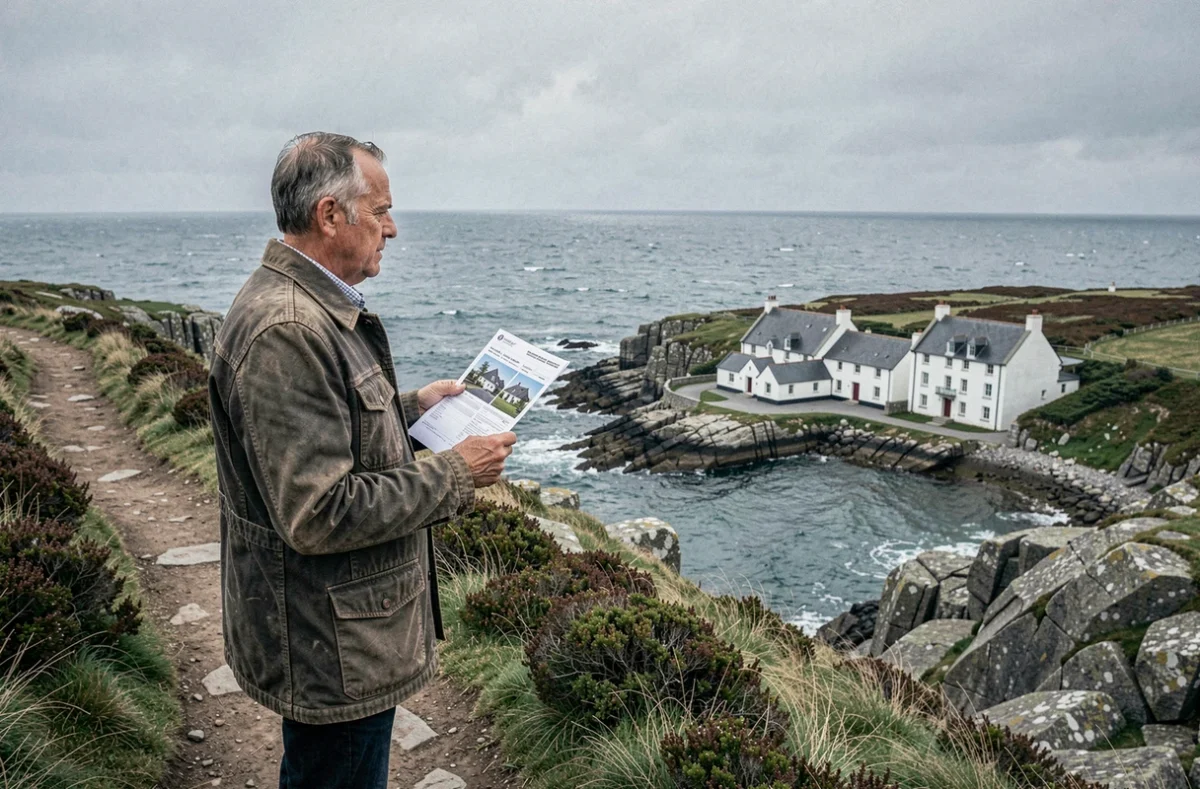
Property financing in Brittany: costs not covered by the asking price
The true cost of buying property in Brittany always exceeds the sale price. Notary fees, which are higher for older properties than for new builds, are a well-known expense. Less obvious costs can add up to even more.
- Energy-efficiency upgrades, which determine whether the property can be rented out and vary considerably depending on the type of construction (stone, timber framing or concrete blocks).
- Additional surveys: non-mains drainage (common in rural Brittany), natural hazards, and the condition of electrical and gas installations in older homes.
- Service charges in older apartment buildings in the city centres of Rennes, Brest or Vannes, where general meeting minutes sometimes reveal approved works that have not yet been billed.
- Property tax, which varies considerably from one Breton municipality to another and has recently been reassessed.
Factor in all additional costs before calculating rental yield to avoid unpleasant surprises. An attractive price per square metre in a mid-sized Breton town can conceal a high overall cost of ownership.
Borrowing capacity and debt-to-income ratio
The maximum debt-to-income ratio remains subject to a strict threshold under recommendations from the HCSF. Yet the amount left over after expenses, often overlooked, determines the buyer’s real financial flexibility. We recommend asking a mortgage broker to model the financing plan before even viewing properties, to avoid considering homes that are beyond the actual budget.
Brittany’s property market remains more affordable than those of southern cities or the Paris region, but affordability is no substitute for careful analysis. A successful property purchase in Brittany depends on checking local restrictions before negotiating the price, not afterwards.