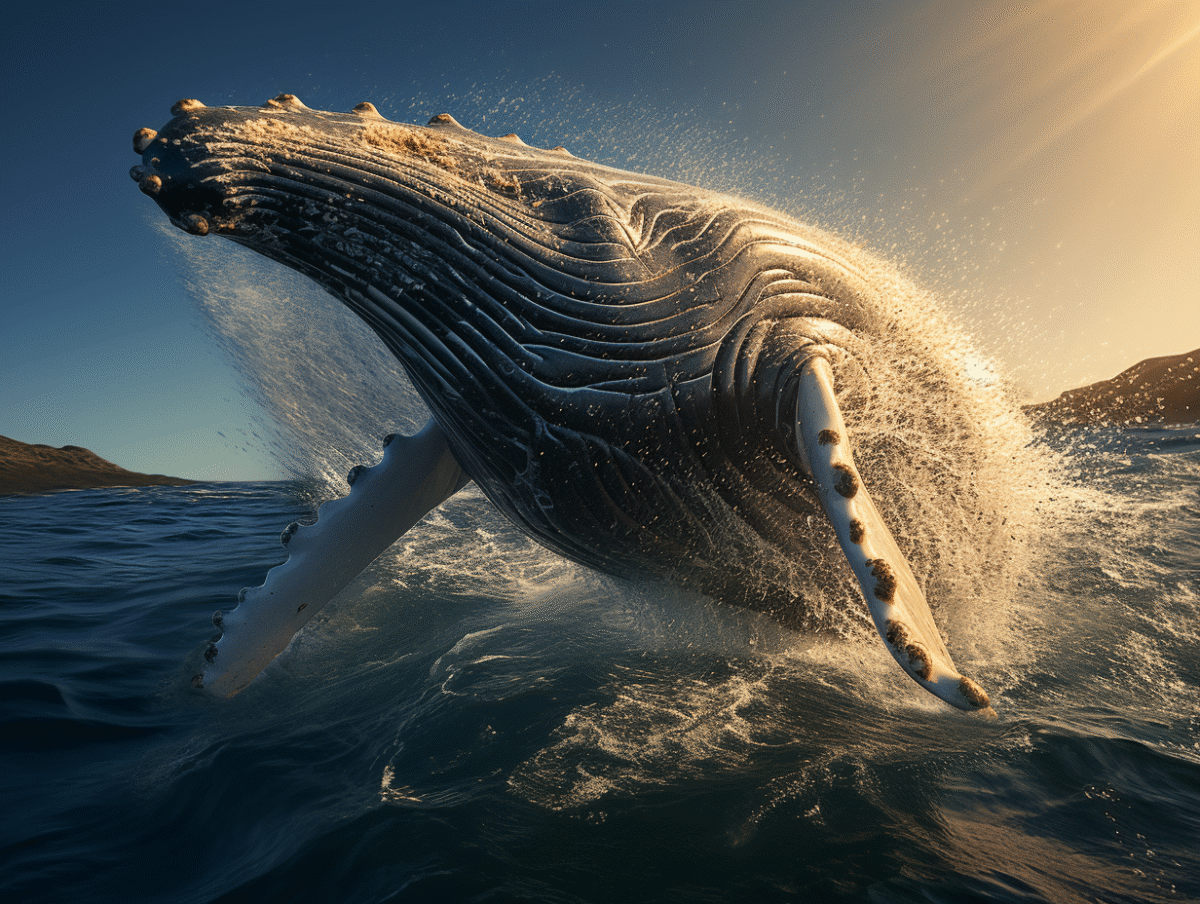
In the vastness of the oceans, whales orchestrate an underwater symphony with their mystical songs, resonating through kilometers of abyssal depths. These vocalizations, both a tool for communication and navigation, fascinate scientists and nature enthusiasts alike. On solid ground, giraffes, with their long necks reaching towards the sky, employ visual signals and infrasound inaudible to the human ear to communicate with each other. These remarkable manifestations of animal communication demonstrate an astonishing diversity and complexity, illustrating the multiple ways in which species share vital information in their respective habitats.
The Secrets of Animal Communication
At the heart of the marine abyss, toothed whales deploy ultrasound for precise navigation and locating objects in the near-total darkness of their environment, a phenomenon known as echolocation. This ability, shared by other creatures such as bats, is a testament to evolutionary ingenuity for survival and hunting in conditions often impenetrable to light. These signals, imperceptible to the human ear, are the result of remarkable adaptation, revealing the extent of communication strategies in the animal kingdom.
Among the giants of the seas, humpback whales stand out for their ability to produce courtship songs of striking musical complexity. These sound sequences, composed of phrases that repeat and evolve, play a key role in animal attraction during the breeding season. Each song is a unique signature that can vary from season to season, as seen in the bowhead whale, whose diverse vocalizations have been observed in the Spitsbergen region. These songs are open windows into the deep social interactions and reproductive behaviors of cetaceans.
On solid ground, animal communication is no less fascinating. While the giraffe’s sound may seem nonexistent to untrained ears, these majestic mammals of the African savannah communicate through infrasound and subtle visual signals. In the canopy, the Costa’s hummingbird employs another form of seduction: by performing spectacular aerial dives, the male creates sounds with its feathers to attract the female. These examples illustrate the richness of animal communication methods and the necessity to preserve these ecosystems where each species has developed its own language to coexist and perpetuate life.

A Symphony of Nature: From Ocean to Savannah
The marine depths and the wild expanses of the savannah vibrate with a natural symphony where each species plays its part. Within this grand orchestra, toothed whales excel in the art of echolocation thanks to sophisticated ultrasound, allowing them to navigate and locate prey in the dark abyss. This refined sound system is a cornerstone of underwater communication, essential for survival in an environment where vision is often limited.
On the surface, the spectacle continues with humpback whales, whose courtship songs represent masterpieces of sound diversity. These musical phrases, which renew and intertwine, contribute not only to animal attraction but also to social cohesion within groups. The bowhead whale, with its variety of songs that change each season, illustrates these marine mammals’ capacity to innovate and adapt in their vocal expression.
Animal behavior in the African savannah is no less remarkable. The Costa’s hummingbird, for example, captivates with an aerial performance where each dive is calculated to produce sounds that attract the female. These natural melodies, though different from those of cetaceans, are equally essential for species maintenance. Animal communication, whether manifested through inaudible ultrasound or spectacular visual displays, remains an eloquent testament to the intelligence and complexity of wildlife.